
Executive Summary
For managed service providers, content marketing can generate thousands of dollars in net-new monthly recurring revenue. Every month, dozens of ready-to-buy businesses in your city are actively searching for IT services. A strong content marketing strategy is what separates the MSP owner who books sales meetings while on vacation from the one who has to make hundreds of cold calls to land a single conversation.
MSPs that run marketing campaigns powered by effective content marketing consistently close larger deals. High-intent inbound leads discover them, build trust, and contact them ready to buy.
In this guide, we will cover the fundamentals of content marketing, how it works for an MSP business, and the first practical steps you can take to get started.
What is Content Marketing?
At its core, content marketing is about serving your audience before asking for anything in return. It’s the strategic use of blogs, videos, case studies, and other formats to educate prospects, address their pain points, and guide them toward a positive outcome.
For managed service providers, content marketing is an especially effective lead generation strategy. Unlike other lead generation methods that use an outbound approach to interrupt potential buyers, content marketing uses an inbound approach to attract in-market buyers through local SEO and social media marketing. When executed properly, it can scale MRR with little to no added pressure on the sales team, creating predictable growth without increasing headcount.
Why is Content Marketing Important?
Your prospects are doing their research with or without you. A strong content marketing strategy ensures that when they go looking for answers, they find your expertise.
Benefits of Content Marketing
Content marketing for managed service providers delivers compounding returns that most other marketing strategies can’t match. It attracts in-market buyers, shortens the sales cycle by pre-educating prospects, and builds genuine credibility in a market full of MSPs making identical claims.
In addition, content marketing is also more cost-effective than other marketing strategies. According to Forbes, content marketing campaigns cost 62% less compared to other channels.
ROI Potential from Content Marketing
In Minneapolis, there are ~5k monthly searches for IT-related services. Conservatively, say 10% of this search volume represents a legitimate business that is in-market. That means there are 500 businesses actively looking for IT services each month. At an average deal value of $3k/month, that would equate to $1.5 million in net-new MRR that MSPs in the Twin Cities are fighting over.
If an MSP obtained 5% search visibility (which is very doable) and had a 20% close rate on pipeline they would generate $15k in net-new MRR every month from content marketing.
As a managed service provider, content marketing is too important to ignore.
Types of Content Marketing
Not every prospect consumes content the same way. A strong managed service provider content marketing strategy draws from multiple formats to meet your audience wherever they are.
Blog Posts
Best for: search visibility and lead generation.
Blog content helps brands attract organic traffic, share insights, and build long-term credibility. It is one of the most versatile and cost-effective forms of content marketing.
- Each post should focus on a single, well-defined topic to maintain clarity and relevance.
- Structured formatting, including headings, bullet points, and short paragraphs, improves readability and engagement.
- A mix of short- and long-form content addresses different user intents and search behaviors.
- Search optimization and internal linking increase visibility and support discoverability.
When executed well, blog content supports every stage of the funnel, from awareness through conversion, and provides a strong foundation for repurposing into other content formats.
Author Tip: One of the most effective ways to scale results is by structuring your content into topic clusters. Here’s a deeper breakdown of how to build topical authority with content clusters.
Social Media
Best for: customer engagement and community building.
Social media content supports brand awareness and engagement at scale. Managed service providers should focus efforts on LinkedIn above other social media platforms. Every piece of content on LinkedIn should either be educational or engaging. No exceptions.
- Social media content should be adapted to each platform’s norms and audience expectations.
- Interactive elements encourage participation and increase reach.
- Cross-channel promotion helps drive discovery by directing audiences to blogs and gated assets.
Both organic and paid social can deliver measurable results, but consistency, creativity, and timing are critical to sustained performance.
Case Studies
Best for: lead generation and building trust.
Case studies showcase real-world results that make it easier for prospects to understand what you can do and how it can help them.
- Case studies can be gated or ungated, depending on the campaign’s objective.
- Define results clearly so it’s easy for prospects to understand the real-world impact of your solution.
- Case studies should be used across every marketing channel to maximize exposure
Videos and Webinars
Best for: Storytelling and customer engagement.
Videos are a great tool for communicating complex ideas or evoking emotion that can drive conversions. We especially like to use videos within retargeting ads as a way to clearly communicate how our MSP clients are better than their competitors.
- Long and short form videos can be used to address various user intents
- Focus each video on a specific topic and pain point and communicate in terms that are easy for nontechnical audiences to understand.
- Showcase what makes your MSP unique through a mini video series.
How to Build a Content Marketing Strategy
A content marketing strategy helps guide managed service providers on content creation, delivery, and measurement. In order to create an effective content marketing strategy, you need to align your audience, message, and offer (AMO) into a unified plan.
Define Your Audience
Start by defining your target audience based on their roles, demographics, and primary pain points. To help you get started, here’s a short list of questions you can use:
- Where are your ideal customers located?
- In the sales process are you working directly with the business owner or other members of the buying committee?
- What size companies are the best fit for your services?
- What problems or challenges are they actively trying to solve right now?
- What triggers typically cause them to start looking for a solution?
- What outcomes matter most to them when evaluating a managed service provider?
- What objections or concerns tend to slow down their decision-making process?
Geographic Considerations for MSPs
For MSPs, it is important to clearly define the geographic area where you can most effectively acquire and serve clients. The key word is effectively. Even if your MSP can technically support businesses across the United States, that does not mean your target market should be that broad.
In most cases, your close rate will be significantly higher within your local market. From a marketing perspective, it is also easier to build awareness, credibility, and relationships in a defined geographic area.
If you are a smaller MSP that operates fully remotely and does not have a physical office, focus on the city you are closest to and treat that as your primary market. This approach helps concentrate your marketing efforts and makes it easier to establish a strong local presence.
Map Content to the Sales Funnel
The sales funnel is made of three steps: awareness, consideration, and conversion. Also known as top-of-funnel, middle-of-funnel, and bottom-of-funnel. Prospects in each stage of the buying journey will have different questions which will require different pieces of content. This is why your content marketing strategy needs to cover all three stages, so you are showing up with the right message at the right time.
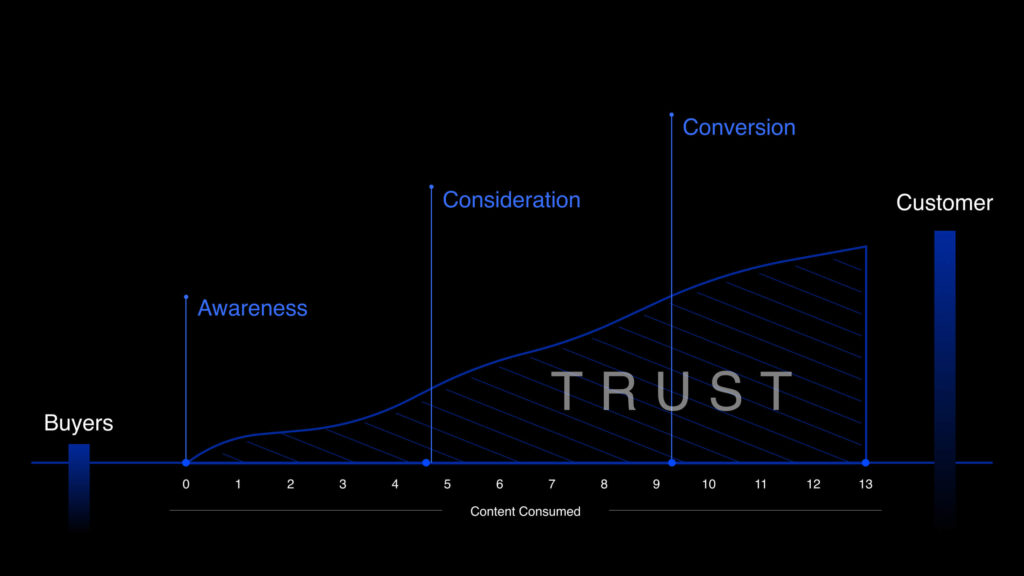
Top-of-funnel Content
In the first stage, the prospect is beginning to feel the pain of a problem but isn’t yet fully aware of what that problem is. The goal of top-of-funnel content is to help them recognize and define the issue, understand why it matters, and introduce a few high-level ways the problem can be addressed.
What to focus on: primary pain points experienced by the prospect.
Content suggestions:
- Business impact of IT downtime
- Average cost of a cybersecurity attack for law firms
- 5 signs your business might be hacked
Middle-of-funnel Content
In the second stage, the prospect has a clear understanding of why their problem exists and they are looking into types of solutions that could address it. The goal of middle-of-funnel content is to clearly communicate what your unique approach to their problem is and why it’s better than alternative approaches.
What to focus on: your unique approach and its real-world impact.
Content suggestions:
- Managed Services Buyers Guide for Minneapolis Businesses
- Case Studies: How Johnson Law Saved $32k/year with IT Net.
- 3rd Party Study: Comparing the Best MSPs in the Twin Cities
Bottom-of-funnel Content
In the final stage, we want to incite action. Our prospect is aware of their problem, vendors they can choose from, and now we want to help guide them towards a meeting with sales.
What to focus on: reduce the perceived risk of your solution and maximize its perceived value.
Content suggestions:
- Pricing pages
- Risk-free guarantees
- Free cybersecurity assessment
Conclusion
Creating content is easy. But creating valuable content that resonates with your audience and can incite conversion is hard and takes time. Quality is always better than quantity. To get started, set a realistic target for new pieces of content to publish every week and block off time in your schedule to make it happen. If you need help getting started or would like a hand to architect a content strategy, let me know. I am happy to help – no strings attached.