
Executive Summary
Here’s a high-level overview on how to build topical authority using content clusters:
- Define a commercial-intent high-volume keyword you want to target.
- Build a pillar page for the keyword.
- Research other topics that can roll up to this main pillar page.
- Create supporting pages for each topic.
- Interlink all pages together to maximize effectiveness.
Below, we’ll walk through each step in detail with real examples focused on local SEO so you can put this to work in your market.
What Is Topical Authority
Google no longer rewards websites that target isolated keywords. It rewards websites that are experts on a specific topic. Websites that provide content covering the topic from multiple angles and in great depth.
Topical authority, in a sense, is the signal you send to Google that your site isn’t just relevant for one query, but it’s the definitive resource on a subject.
How Google Evaluates Expertise on a Topic
Google looks at your site holistically, not by page. It assesses how well your content covers a topic area by evaluating the depth of content across pages.
For MSPs, this means Google isn’t just looking at your “Managed IT in Minneapolis” page in isolation. It’s looking at whether you have the supporting content.
Put yourself in Google’s shoes. Whom would you trust more? An MSP marketing agency that has one blog on SEO for managed service providers or an agency that has a hundred blogs on SEO for MSPs?
Would you rather go to a surgeon who has performed one heart surgery or a surgeon who has performed hundreds?
Experience matters. Google’s currency for experience is topical authority (topical depth).
Why One Great Article Isn’t Enough
A single well-optimized geo page can only do so much. The MSPs that consistently rank across competitive local markets aren’t just running one strong page. Instead, they’re using a network of interconnected pages that cover every angle of the buyer’s journey.
This is the strategy we use for our MSP clients. And it works. Trust me.
What a Content Cluster Actually Looks Like
A content cluster is a group of pages on your website, all focused on the same core topic, linked together in an intentional structure.
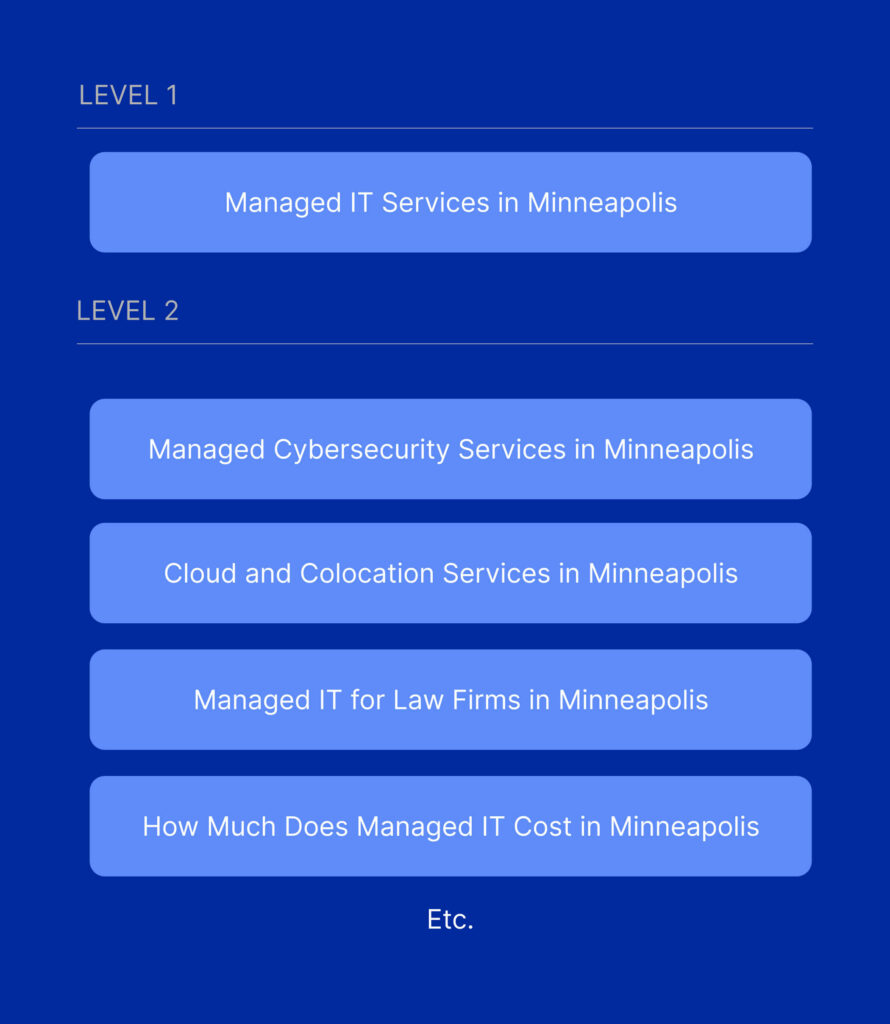
The Pillar Page
The pillar page is your primary, “money page”. For an MSP, this is typically a geo page; something like “Managed IT in Minneapolis.” It covers your core service offering, establishes relevance for the location, and serves as the hub that all supporting pages connect back to.
Cluster Pages
Cluster pages dive deeper into specific subtopics that live beneath the pillar. For an MSP targeting Minneapolis, this might look like:
- Managed Cybersecurity Services in Minneapolis
- Cloud and Colocation Services in Minneapolis
- Managed IT for Law Firms in Minneapolis
- How Much Does Managed IT Cost in Minneapolis
Each of these pages addresses a more specific search query. Together, they signal to Google that you 1.) have deep expertise in IT services and 2.) you have a deep understanding of the Minneapolis market.
Internal Links: The Glue That Makes It Work
If each page is a building block, then internal linking is the glue that holds everything together. Here’s why internal linking is important:
- Improves the experience of the reader so they can branch off into other subtopics
- Improves crawlability for the entire content cluster
- Passes link juice (page rank) from one page to another
Structurally, here’s how it should be implemented:
Every cluster page should link back to the pillar, and the pillar links out to each cluster page. Where relevant, cluster pages also link to each other.
How to Build Your First Content Cluster
Step 1: Choose a Core Topic Worth Owning
Start with a service and geography combination that’s central to your business. For most MSPs, this is a city-level service page (Managed IT in Minneapolis). Validate that real search demand exists before building around it. Tools like Ahrefs or SEMrush can confirm monthly search volume and show you what related queries are being searched.
Don’t try to own everything at once. Pick one market, build depth there, then expand.
Step 2: Research and Map Your Subtopics
Use Google’s “People Also Ask” boxes, keyword research tools, and competitor analysis to find what buyers are actually searching alongside your core topic. Look for intent variations: informational queries (“how much does IT support cost”), comparison queries (“best IT support companies in Minneapolis”), and industry-specific queries (“IT support for manufacturers in Minneapolis”).
These become your cluster pages.
Step 3: Build the Pillar Page First
Your pillar page should broadly cover your offerings in that market. Talk about whom you serve, what’s included, and why local businesses choose you. It doesn’t need to go exhaustively deep on every subtopic (that’s what the cluster pages are for), but it needs to be comprehensive enough to stand on its own. Link out to your cluster pages as you build them.
Step 4: Write Supporting Cluster Pages
Each cluster page should go deep on its specific angle without duplicating what the pillar page covers. Your “IT Support for Law Firms in Minneapolis” page, for example, should speak directly to the common pain points law firms experience with IT downtime and how you’ve helped (or can help) law firms overcome these challenges. You could also have a section that touches on cybersecurity and compliance requirements that relate to law firms, which can link to another support page on “managed cybersecurity in Minneapolis”.
Common Mistakes That Kill Topical Authority
Going Too Broad
Don’t try to rank for “IT Support” on the national level. The amount of money and time that this would take is enormous. Similarly, don’t try to rank for every city and every service at once. That will spread your content too thin. Build a complete cluster for one market before moving to the next. Remember, 60% of all clicks happen in the first 3 positions on Google. Ranking in position 10 for 4 pages will produce fewer clicks than ranking in position 3 for 1 page.
Keyword Cannibalization Between Cluster Pages
If two pages are targeting the same search query, they’ll compete against each other. Your “IT Support Pricing in Minneapolis” and “How Much Does IT Support Cost in Minneapolis” pages need to be clearly differentiated or consolidated into one document.
How to Know If It’s Working
Track Cluster Performance as a Group
Don’t evaluate pages in isolation. Look at how the entire cluster is performing. Track total impressions, clicks, and keyword coverage across all related pages. A rising tide across the cluster means your topical authority is growing.
Watch for Ranking Improvements Across Related Keywords
As your cluster matures, you should start ranking for search terms you didn’t explicitly target (which is super cool). This means that Google now recognizes you as a credible source and is surfacing your content for adjacent queries.
Look for Featured Snippet Wins and Growing Impressions
Featured snippets and “People Also Ask” appearances often go to sites with strong topical authority. Track these as early indicators that Google is beginning to trust your content on the topic.
Conclusion
Understanding how to build topical authority through content clusters is critical for marketers. In practice, it takes time and effort to execute. But the rewards are worth it. Not only will it help boost your rankings, but it will also improve the overall efficiency of your SEO content marketing strategy.