
When marketers ask, “Is adding too many keywords bad for Google Ads?” the question almost always comes from the same place: a desire to capture more search traffic, more visibility, and more chances to show up in search results when potential customers are actively looking for solutions. This comes up frequently in conversations around MSP AdWords management and strategy, where the pressure to cover every possible service, location, and industry can quickly lead to keyword overload. On the surface, it makes sense. More keywords mean more coverage. More coverage means more clicks. More clicks should mean more conversions. In practice, though, it is rarely that simple.
Adding keywords does not automatically improve or hurt performance. What matters is how those keywords are structured inside your Google Ads campaigns, how well they align with user intent, and whether Google can clearly understand what each ad group is actually trying to accomplish. Done with discipline, expanding keyword lists can improve click-through rates and conversions. Done without it, you end up with bloated campaigns, wasted spend, and poor user experience. Sometimes more is better. Sometimes it is not.
Why Advertisers Keep Adding More Keywords
Most advertisers don’t add hundreds of keywords carelessly. They do so because keyword tools make it easy. A few clicks in Keyword Planner can yield thousands of ideas—each showing good search volume and feeling like a missed opportunity if excluded. Fear is also a factor: the idea that a specific keyword out there converts better than any other, and not including it means losing sales. This fear drives advertisers to add every variation—singulars, plurals, reordered phrases, near synonyms, and rarely searched long-tail terms. The issue isn’t having many keywords.
The issue is uncontrolled keyword expansion. Without considering search intent, advertisers build ad groups aimed at everyone. As a result, ads stop connecting with anyone in particular.
How Google Ads Actually Treats Keywords Today
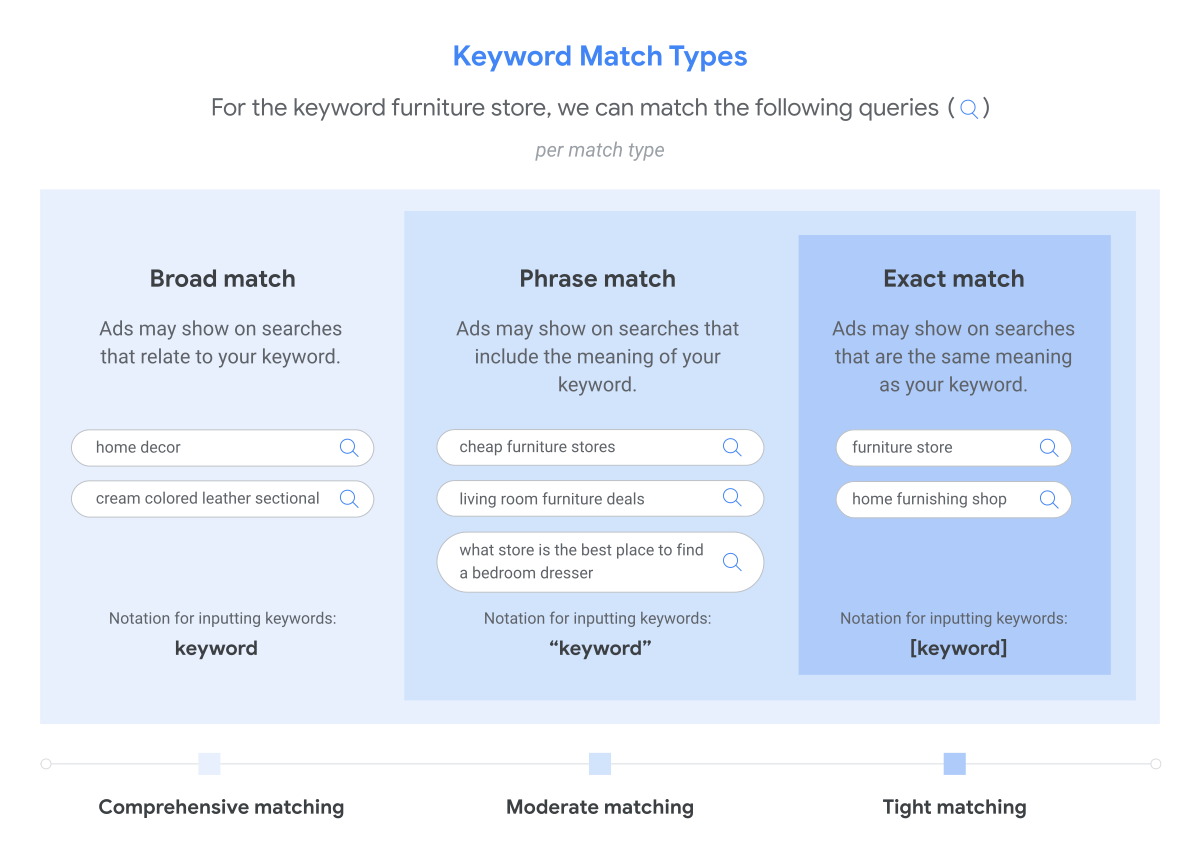
Google Ads no longer works the way it did years ago, when a keyword only matched the exact phrase typed into the search bar. Today, Google evaluates search queries based on meaning, context, and user intent rather than just literal wording. Phrase match keywords can trigger ads for searches that include additional words before or after the phrase. Even exact-match keywords are now interpreted more flexibly, often matching searches with the same meaning rather than the same structure. This means that multiple keywords inside the same Google Ads account can compete to trigger the same search results. That overlap scares many advertisers. They worry about redundancy, wasted spend, and keyword conflicts. In reality, Google is constantly testing which ad produces the best outcome for each search, factoring in relevance, expected click-through rates, and historical performance. Redundant keywords do not confuse the system nearly as much as poorly structured ad groups do. Google wants to show the best possible ad for every search. Always.
How Too Many Keywords Can Hurt Performance
Diluted Relevance
When ad groups contain too many loosely related keywords, ad relevance suffers. Your ad copy becomes generic because it must address too many ideas, and your landing pages struggle to match what the searcher wants.This is where keyword density starts to matter, not in the SEO sense, but in terms of message match. If your ad cannot clearly reflect the intent behind a specific keyword, Google notices. So do users.
Slower Learning and Weaker Signals
Another real issue is data dilution. When spend is spread across dozens or hundreds of low-volume keywords, it takes Google much longer to learn what works. Individual keywords may never generate enough clicks or conversions to optimize properly, especially when search volume is limited. This delays performance improvements and complicates optimization. Reports fill with keywords that have impressions but no results. A lot of noise.
Very little signal.
Budget Waste and Overlap
Too many keywords without proper negative keywords almost guarantees wasted spend. Overlapping keywords can trigger the same search queries, creating internal competition and inefficient bidding. Instead of focusing the budget on the most relevant keywords, your spending gets scattered across them. This is often mistaken for scaling.
It is not.
When Adding More Keywords Actually Works
Here is where things get interesting, because adding more keywords is not always bad. In fact, when done intentionally, it can dramatically improve performance. More keywords allow for more specificity. When each keyword or small group of keywords has its own tightly aligned ad copy and landing page, relevance improves. Click-through rates go up. Conversion rates follow. The user experience improves because people see exactly what they searched for reflected in the results. This is why highly segmented accounts often outperform simpler ones in the long term. Google has more relevant ads and combinations to test, increasing the chances of finding what works for each search intent. Redundancy becomes irrelevant because performance decides the winner.
How Many Keywords Is Too Many?
This is where most advertisers want a hard rule, but the honest answer is unsatisfying. There is no universal limit. That said, asking how many keywords is too many is still a useful question when applied at the ad group level. As a general rule, most high-performing ad groups contain 10-20 relevant keywords. Some contain fewer. Some can support more. The deciding factor is whether all the keywords share the same intent and can be served by the same ad and landing page.If you find yourself asking, “How many keywords should I use?” in AdWords style, the better question is whether your ads can genuinely speak to every keyword in the group. If not, the group is too large. Simple.
Multiple Ads and Keyword Overlap
One concern that comes up frequently is AdWords multiple ads with the same keywords, and whether that overlap causes issues. In practice, Google is constantly testing which ad performs best for a given search. Even when keywords overlap, Google evaluates ads based on expected performance.This means that having multiple ads and keywords can actually improve results, as long as each ad is written with a clear intent. Google will favor the ad that produces better engagement, regardless of which keyword technically triggered it.
Best Practices for Scaling Keywords Without Hurting Results
If you want to expand keyword coverage without damaging performance, discipline is everything.Group keywords by intent, not just words. Use negative keywords aggressively to stop overlap and irrelevant traffic. Focus on long-tail keywords signaling clear intent, not just on search volume. Regularly review search queries to see how people find you. And make sure the number of keywords you target is in proportion to your daily budget. Remember that SEO keywords and paid keywords serve different purposes. Paid search is about precision, not coverage. A clean Google Ads account with fewer, highly relevant keywords will almost always outperform a cluttered one filled with guesses. Keyword stuffing does not work in paid search any more than it does in SEO.
Final Thoughts
So, is adding too many keywords bad for Google Ads? It can be. But it does not have to be. Too many keywords without structure leads to wasted spend, poor relevance, and weak performance. More keywords, when paired with clear intent, disciplined grouping, and strong ads, can unlock higher click-through rates, stronger conversions, and a better user experience. The goal is not fewer keywords or more keywords.
The goal is not to have more or fewer keywords. The goal is to have the right keywords, structured by intent, to maximize your results.