
Here’s the secret that most SEO agencies don’t want you to know: Google doesn’t just evaluate what’s on your website. It also evaluates what the rest of the internet thinks about your website.
That’s where off-page SEO comes in.
Summary of How Off-Page SEO Impacts Website Rankings
Authority: Backlinks act as votes of confidence from other websites indicating to Google that you are an authority on a subject matter.
Credibility: Brand mentions and reputation signals reinforce trust by showing that your business is recognized and discussed across the web, even without direct links.
Visibility: Backlinks from press releases boost visibility by expanding your reach across authoritative publications and giving your site additional referral traffic and opportunities to earn secondary backlinks.
According to Brian Dean, Rand Fishkin, and other SEO industry leaders, off-page SEO remains one of the most important foundations for SEO in 2026.
What is Off-Page SEO
Off-page SEO is the process of building external signals (happening outside your website) to improve how your site ranks in search results.
Traditionally, off-page SEO focused heavily on backlinks—getting other websites to link to yours. And while that’s still a core piece, the definition has expanded.
Today, off-page SEO includes:
- Backlinks from authoritative websites
- Brand mentions (linked or unlinked)
- Social media visibility and engagement
- Reviews and local citations
- Digital PR and partnerships
In short: it’s your digital reputation. And in 2026, that reputation extends beyond Google.
Search is no longer limited to traditional results pages. AI-driven tools and LLMs (like ChatGPT, Google AI Overviews, and others) now pull information from across the web. That means SEOs must think about how their brand is referenced, cited, and discussed—not just linked.
If your company shows up consistently across trusted sources, you’re more likely to be included in both search results and AI-generated answers.
On-Page vs Off-Page SEO
Here’s the difference between on-page and off-page SEO:
On-page SEO = what you say about yourself
Off-page SEO = what others say about you
On-page SEO includes your content, keywords, site structure, and internal linking. It helps search engines understand your website. Off-page SEO, on the other hand, helps search engines trust your website.
A phrase that we often say at our agency is: “Content puts you in the game. Backlinks are what helps you win it”. You can have the best content in the world on your website but if no one links to it or mentions it you are going to struggle to rank.
That’s why both are required. One builds relevance. The other builds authority.
Off-Page Strategies That Work
Not all off-page SEO is created equal. In the last few years Google has rolled out a number of updates (notably Penguin and SpamBrain) which have tightened its scrutiny on the types of off-page signals that move the needle.
Here are a handful of strategies that you can implement to actually move rankings:
1. Link Building (Still the backbone)
High-quality backlinks from relevant, authoritative sites remain one of the strongest ranking signals.
But quality > quantity.
A single link from a respected industry publication can outweigh dozens of low-quality links.
2. Digital PR
Getting featured in articles, contributing expert insights, or publishing data-driven content can earn backlinks and brand mentions at scale.
This is one of the fastest ways to build authority.
3. Guest Content & Partnerships
Writing for other websites or collaborating with partners introduces your brand to new audiences—and earns valuable links in the process.
4. Brand Mentions
Even without a link, consistent mentions across the web signal credibility.
Search engines, and increasingly AI systems, use these references to evaluate trust.
5. Social Distribution
Social media doesn’t directly impact rankings, but it amplifies your content.
More visibility → more shares → more links.
6. Local SEO (for service providers)
For MSPs especially, reviews, citations, and an optimized Google Business Profile are critical.
They help you show up when buyers are actively searching in your market.
Example of the Impact Off-Page SEO has on Rankings
The image below is from a keyword rank tracker, a tool that SEOs use to identify movements in keywords that are being targeted within a campaign. As you can see, after 6 days of placing a link to the target page rankings substantially improved from not ranking at all for the target keyword to obtaining the 1st position in the SERP.
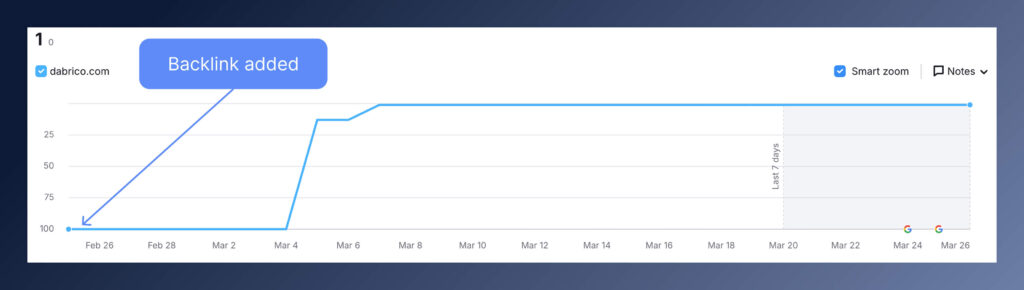
Disclaimer: This was an anomaly in terms of the dramatic impact the backlink had on the site’s rankings. Most backlinks drive modest improvements of a few gain positions. In some cases they can take days or even weeks for their effectiveness to carry over.
Is Off-Page SEO Still Relevant in 2026?
Yes and arguably more than ever. But, strategies that work in 2026 are different from what’s worked in years past. It’s no longer just the quantity of backlinks you are building. Instead, it’s more about building a presence. Successful SEOs are taking a broader, more wholistics approach to offpage that influences both Google and LLMs. Make sure your SEO campaign has a healthy mix of on-page and off-page activities so you’re not just optimized but your site has the power to outrank your competitors.