
Most B2B brands pour their entire SEO budget into national rankings, chasing high-volume keywords against massive competitors with ten times their domain authority, and then they wonder why they aren’t seeing results. The businesses that are quietly winning new clients every month are the ones that figured out something deceptively simple: local SEO works for B2B.
Based on my experience as a search engine optimization consultant for managed service providers and other B2B brands, local SEO for B2B consistently delivers higher-quality leads at a lower cost than national campaigns. This guide breaks down exactly what B2B local SEO is, why it matters, and the practical framework you need to start generating an inbound pipeline from your local market.
What Is Local SEO for B2B?
B2B local SEO is the process of optimizing your website and Google Business Profile (GBP), so your business ranks in organic search engine results for geographic-specific keywords. When a prospect in your area searches for the services you offer, local SEO is what determines whether they find you or your competitor.
Examples of local SEO search terms
- “Managed IT services near me”
- “Cybersecurity consultant in Cincinnati”
- “Managed service provider in Ohio”
Differences between Local SEO and National SEO
The main difference between local SEO and national SEO (regular SEO) is the search engine results page (SERP). At the top of the SERP in local SEO is an extra section called the Local Pack (aka Map Pack). The Map Pack consists of a map with 3-4 Google Business Profile (GBP) listings underneath it. The rest of the SERP looks fundamentally the same, with paid and organic search results.
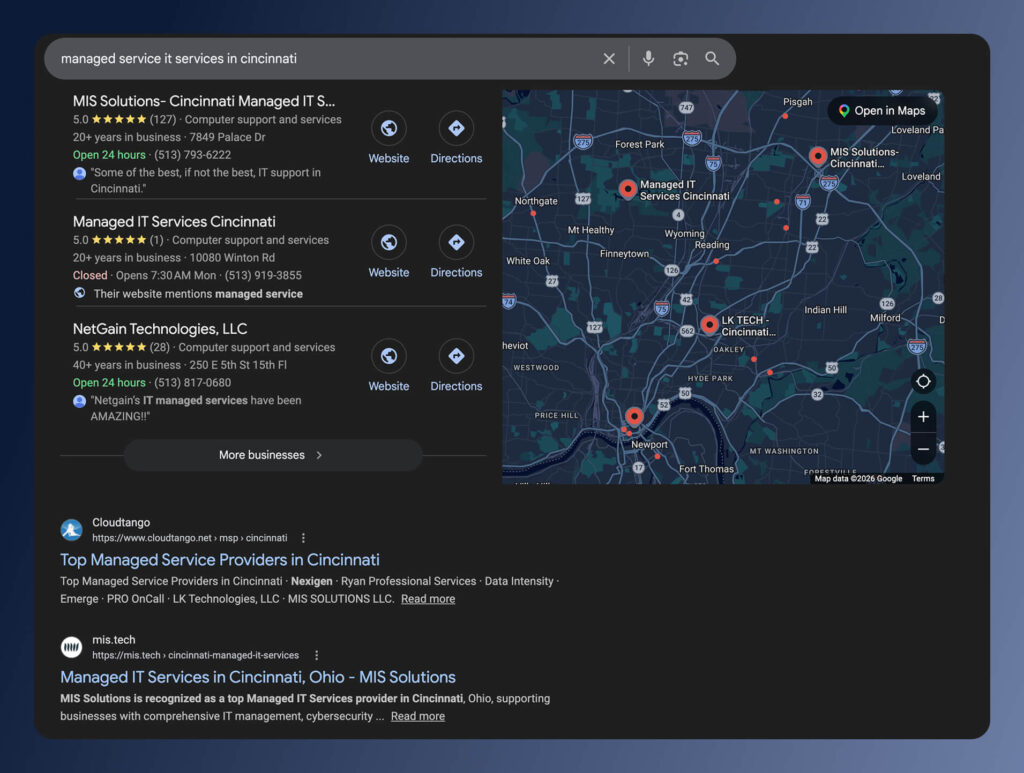
Benefits of B2B Local SEO
If you are a B2B brand that sells specifically to buyers in your local market, local SEO has the potential to become the single largest revenue source for your business. Here are five reasons why:
- Lower competition compared to national SEO, which means faster results and a lower barrier to entry for smaller businesses
- Higher-quality leads because prospects searching locally are often closer to a buying decision and are actively looking for a provider in your area.
- Increased visibility in the local results where your target local audience is already searching, which helps boost visibility across your entire marketing funnel
- Faster ROI since you are not competing against every provider in the country, just the ones in your market
- An opportunity to build real awareness and trust in your local market before trying to scale nationally
Based on my experience working with MSPs and other B2B service providers, local SEO strategies are the fastest path to meaningful pipeline growth for companies that serve a defined geographic region.
Primary Objectives of Local SEO
There are two primary objectives in local SEO: rank in the Map Pack with your GRP and rank in the organic results with a location-specific landing page.
In the next four sections, we will cover everything you need to know to rank both assets so your business can start generating leads with Local SEO.
Step 1: Optimize Your Google Business Profile
The Map Pack is at the top of the SERP, meaning that it generally produces the most clicks and, in turn, leads. Properly optimizing and managing your GBP is critical to dominate the local SERP. Here’s how to properly set up your GBP…
Choose the Right Primary Category
Your primary category is one of the most important ranking signals Google uses to decide when to show your profile. For IT service providers, “Computer Support and Services” is usually the best fit. For other B2B companies, spend the time to find the category that most precisely matches your core offering.
Add Relevant Subcategories
Subcategories give Google a more complete picture of what you offer and help your profile surface in a wider range of local searches. You can add up to nine. For MSPs, I typically recommend subcategories like “Computer Security Service,” “Computer Networking Service,” and “Business to Business Service.” Pick the ones that accurately reflect your services.
Author Tip: Download the free tool GBP Everywhere to spy on your competitors and understand which categories they use.
Write a Strong Business Description
Your GBP description should clearly communicate who you are, what you do, and where you do it. Lead with your primary service and location, weave in relevant local keywords naturally, and think of it as a concise pitch to both Google and the business owner who is about to decide whether to call you. Keep it under 750 characters and make every word count. I also recommend implementing business schema markup on your website so search engines can better understand your service area, hours, and contact information, which directly supports your local search performance.
Step 2: Manage Your Google Business Profile
Setting up your Google Business Profile is step one. Keeping it active and optimized is where most businesses fall off. Consistent management of your local listings is what separates the B2B brands that dominate the local pack from those that never show up.
Reviews Management
Positive reviews are the second-most-important ranking factor in the local pack (behind choosing the right primary category). Do not leave review acquisition to chance. Google disproportionately favors review velocity over pure review volume, so even if a competitor has 125 reviews and you have 25, consistently gaining new reviews each month can close that gap fast.
NAP Consistency Across Local Listings
Your business name, address, and phone number (NAP) need to be identical across every platform where your company is listed. Your website, your Google Business Profile, local directories, industry listings—all of it. This is one of those things that sounds simple but gets messy fast, especially for businesses that have been around for a while and have old data floating around the internet.
Step 3: Build Location Pages for Organic Local Search
Everything above focuses on the local pack. Now let’s talk about ranking in organic search results and how to increase visibility.
Conduct Keyword Research
Start by using a keyword research tool like SEMrush or Ahrefs to identify how prospects in your area search for your core services. List your main offerings and the common ways they get phrased.
Example
- IT support
- helpdesk
- managed IT services
- managed cybersecurity
Then, rotate city names through your search to generate localized keyword opportunities.
Example:
- IT support in Cincinnati
- helpdesk Cincinnati
- managed IT services Ohio
- managed cybersecurity in Ohio
Author Tip: Here’s a full guide on how to conduct B2B keyword research
Develop a Scalable Template for Location Pages
Before you start creating pages, build a standard template. I have found a lot of success with a structure that includes a hero section focused on the key outcome, a section addressing common challenges, trust signals, and client logos, a case study from the local area, an in-depth list of your solution’s features, FAQs, and lastly a strong call to action. Use a consistent template across all location pages and customize the copy, imagery, and internal links for each city.
Step 4: Building Local Authority with Backlinks
Content gets you in the game. Backlinks are what bring you to the top.
What Backlinks Are and How They Are Created
A backlink is a link pointing from another website to yours. Say for example, BestMSP.com is writing an article on the Best MSPs in Ohio, and they add a link in their article that references your website, this would create a backlink.
Why Backlinks Are Important
Since Google can’t read, it has to rely on external signals to determine which pages are the “best.” Backlinks are one of the most important external signals that Google uses. Google views a backlink as a vote of confidence, indicating that your content is “good” and therefore deserves more visibility in the SERP.
Building Local Backlinks
Start by listing customers, vendors, referral partners, and other local businesses you already have strong relationships with. These are the easiest backlink opportunities because trust is already in place.
Next, reach out and clearly explain the mutual benefit of a backlink exchange. Be specific about which page on their site could naturally link to yours.
From there, take full ownership of the process. Write the content for both sides, include the backlink naturally, and hand off a finished piece ready to publish. When you do the heavy lifting, you remove friction and make the approach far more scalable.
Final Thoughts on Local SEO for B2B Brands
Search is evolving. After Google rolled out AI summaries, many brands saw organic click-through rates drop as answers began appearing directly in the results. The old spray-and-pray approach to SEO no longer works. B2B companies need a clear local SEO strategy built on authority, relevance, and trust to consistently generate high-quality inbound leads.
Local SEO in 2026 is about maximizing your brand’s real estate in the SERP, not just ranking a single page. The strategies in this guide are not easy to implement but they do work. Our clients at DYAD generate hundreds of thousands in net new pipeline every month using this framework. Whether you are looking to grow your regional presence through better marketing services or you just want more local traffic from search, the playbook is here. If you need help getting started, drop me a line on LinkedIn.