
45% of B2B buyers surveyed by Gartner used generative AI during a recent purchase, primarily to research vendors and products. For managed IT service providers, that creates another opportunity to reach businesses evaluating their next technology partner. Your prospects can discover you through Google, ask ChatGPT to compare providers, and use Claude to evaluate their options before contacting anyone.
We’re already seeing this translate into revenue. Several of DYAD Marketing’s clients have closed five-figure MSP contracts from leads directly attributed to ChatGPT and Claude. These results show how AI visibility can connect MSPs with buyers who are actively evaluating providers and ready to start a conversation.
AI search optimization for MSPs means improving the likelihood that your business is discovered, accurately described, and recommended when buyers use AI to research IT providers. It combines strong SEO with useful content and credible evidence about your business. This guide explains where to focus that work and how to connect it to qualified leads and MRR.
SEO, AEO, and GEO: What MSPs Need to Know
SEO, AEO, and GEO describe overlapping approaches to improving online visibility. The terminology can make them sound like separate marketing programs, but much of the underlying work serves multiple purposes.
| Channel | Where You Appear | Goal | What Winning Looks Like | How You Measure It | MSP Example |
| SEO | Regular Google and Bing results | Rank high and earn the click | Your page appears in the top three organic results | Rankings, clicks, organic leads | Ranking for “managed IT services Minneapolis.” |
| AEO | Answer features in search results, including AI Overviews, featured snippets, and People Also Ask | Be featured in the answer | Your content is quoted or linked in an answer feature | AI Overview, snippet, and People Also Ask appearances | Your pricing page is cited in an answer to “How much do managed IT services cost?” |
| GEO | AI tools and experiences, including ChatGPT, Gemini, Perplexity, Claude, and Google AI Mode | Be named in the AI’s response | Your company is included in a shortlist of providers | Mentions and citations in AI answers, AI referral traffic | Your MSP is recommended when a buyer asks for IT providers serving accounting firms in Manhattan. |
The boundaries between AEO and GEO are not standardized, and the terms are frequently used interchangeably. For an MSP, the useful distinction is between having information quoted as an answer and having the business included as a potential provider. Both can create visibility, but a recommendation tied to a buyer’s requirements is more directly connected to a sales opportunity.
Traditional SEO remains part of this work. Google states that existing SEO best practices apply to AI Overviews and AI Mode, with no additional optimization requirements for inclusion. That supports an integrated approach to conventional search and AI visibility.
For a deeper explanation, see our guide to the differences between SEO, AEO, and GEO.
How to Improve Your MSP’s Visibility in AI Search
Improving your MSP’s visibility in AI search starts with a clear target. Before creating content, pursuing coverage, or changing your website, establish which buyers you want to reach and what would make your business relevant to their search.
1. Define What You Want to Be Recommended For
With conventional keyword research, search-volume estimates help prioritize opportunities. For conversational AI prompts, we don’t have an equally dependable view of how often buyers ask each question. We need to combine keyword research with an understanding of how customers evaluate MSPs.
Start with a simple exercise: if you were your ideal customer and were looking to switch to a new MSP, what would you ask?
- Who is the best MSP in Cincinnati?
- Which MSP is best in Cincinnati for law firms?
- Best co-managed IT provider for a multi-location healthcare organization
- Which MSPs in Cincinnati have the best reviews?
- Which MSPs are the most affordable in Cincinnati?
Each question introduces criteria that could influence a recommendation: industry experience, reputation, pricing, location, or contract flexibility. Choose the criteria that match your actual strengths. A provider offering specialized, high-touch support may have little reason to prioritize searches for the cheapest MSP.
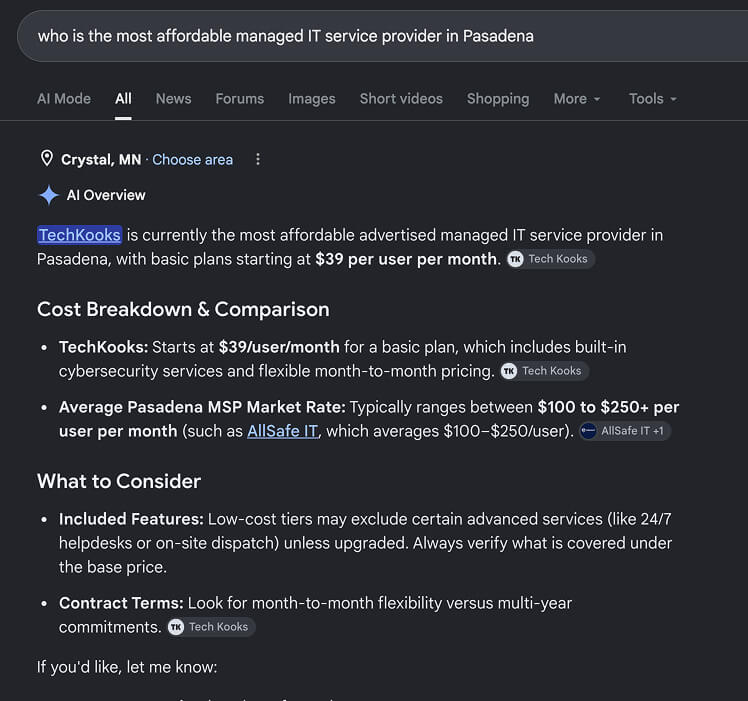
Quick example: one of our clients, Tech Kooks, has REALLY competitive pricing. They wanted to be known as the “most affordable MSP” in their city. By using our proprietary GEO/AEO tactics we were able to influence AI Overviews to list their brand as THE most affordable MSP in Pasadena (their city of business).
2. Build SEO Content Around Buyer Questions
Your core pages should clearly communicate who you are, what you do, and why you’re the right choice. For an MSP, that means explaining the businesses you serve, the services and geographic areas you cover, and the strengths that make you a good fit. Build dedicated pages for core services, priority cities, and industries where you have relevant experience, tailoring each page to the questions that audience asks when evaluating providers.
I’ve written hundreds of these pages, and the most useful ones go beyond describing the service in general terms. An accounting IT page should explain how you support firms during tax season and which applications your team works with. A location page should clarify onsite availability and the area you actually cover.
Aim to contribute information buyers cannot find in a dozen competing articles. This is often called information gain: adding useful details, original insights, or firsthand knowledge to the topic. For an MSP, that could mean explaining your onboarding process, sharing practical experience with an industry-specific application, or breaking down how you calculate pricing. More words alone do not make a page more useful.
Address the questions prospects ask when comparing providers:
- What does the managed IT agreement include, and what costs extra?
- How does onboarding work, and what does the client need to prepare?
- What are your support hours and response commitments?
- What factors affect pricing, and can you provide a realistic range?
- How do responsibilities change when the client already has an internal IT team?
Answer each question directly, then add enough detail to help the reader make a decision. Use descriptive headings and comparison tables where appropriate, and group related questions together. Finish with a clear next step, such as booking a consultation or requesting a quote.
3. Support Your Claims With Client Results and Expertise
Of those three questions, “why you’re the right choice” takes the most work to answer convincingly. Claims such as “industry-leading support” or “the best MSP in Minneapolis” need evidence behind them, especially when competitors make similar promises.
Use case studies, testimonials, relevant awards, third-party ratings, and current certifications to substantiate your positioning. Match the proof to the claim: a healthcare client’s experience supports your industry expertise, while documented response performance helps demonstrate fast service. Include context for awards and ratings so readers understand who provided them and what they represent.
A strong case study explains the client’s problem, what your team did, and what improved. Include measurable outcomes when documented, and distinguish past results from contractual guarantees. Place this evidence alongside the relevant service or industry content so buyers can evaluate your claims without searching through the rest of your website.
When someone arrives after an AI recommendation, your website should help them verify what they were told. Relevant proof gives them concrete reasons to trust your MSP and take the next step.
4. Strengthen Your Presence Across 3rd Party Sources Used in Generative Search
Traditional SEO focuses heavily on ranking your website, with external signals such as backlinks supporting that visibility. For AEO and GEO, the focus extends to how other sources describe and recommend your MSP. A 2026 Muck Rack study analyzing more than 25 million links from ChatGPT, Claude, and Gemini responses found that 84% of citations came from earned media. Reviews, business directories, partner listings, industry publications, and public discussions can help reinforce your expertise and give AI platforms additional sources to draw from when answering buyer questions.
Start by running your target questions and examining the responses when web search is enabled. Record which businesses appear, which pages are cited, and whether those sources accurately represent your market. A cited source is worth investigating, although its presence does not prove it caused a particular recommendation.
Use that research to identify relevant opportunities:
- Keep your Google Business Profile and other important business listings accurate.
- Ask clients for honest reviews through a consistent process.
- Maintain profiles in relevant industry and partner directories.
- Pursue coverage built around actual expertise, research, or noteworthy client work.
- Contribute useful answers in professional communities where potential buyers participate.
Prioritize sources that matter to your buyers and market. A relevant association listing or substantive industry article may offer more practical value than dozens of unrelated directory profiles. Keep descriptions of your services, locations, and specialties consistent, and correct outdated information when you find it.
These activities build a more complete public record of your business. Treat their effect on AI recommendations as something to measure, rather than assuming that a new mention or placement will produce inclusion.
5. Get the Technical Foundations of AI Search Optimization Right
Useful content must be accessible before it can support search visibility. Have your website team check that important pages can be crawled, are eligible for indexing, and are connected through internal links. Essential service information should be available as readable text, and any structured data should match the visible page content.
Google requires pages to be indexed and eligible for search snippets to appear as supporting links in AI Overviews or AI Mode. It does not require special AI schema or an AI-specific text file. Meeting those requirements establishes eligibility, but does not guarantee inclusion.
For other platforms, review their current crawler documentation before changing access rules. Avoid assuming that every AI-related bot performs the same function. Your technical team should understand the purpose of each setting and check whether hosting or security tools are unintentionally blocking access you want to permit.
How to Measure AI Visibility and Inbound Leads
AI visibility becomes useful when it connects to business outcomes. I recommend measuring three layers: whether your MSP appears in relevant answers, whether those interactions bring people to your website, and whether the resulting inquiries become qualified opportunities.
Track Your MSP Across Relevant Buyer Prompts
Start with three to five purchase-focused questions for each priority service. Include the location, industry, or company characteristics that matter to your target customer. Use the same core questions over time so that changes in your testing do not get confused with changes in visibility.
A practical starting set of platforms is ChatGPT, Claude, and Google’s AI search features. Record the platform, date, prompt, and whether web search was enabled or an AI answer appeared. Use fresh conversations for comparable checks and record relevant settings or location context.
For each response, track:
- Whether your MSP is mentioned.
- Whether it is recommended as a provider or only cited as a source.
- Whether the description of your services is accurate.
- Which competitors appear.
- Which sources are cited.
Mention rate provides a simple starting metric:
Mention rate = responses mentioning your MSP ÷ total responses checked × 100
If your MSP appears in 12 of 40 responses, its mention rate within that sample is 30%. That figure describes your test set, not your share of all AI searches. Review platforms separately and repeat checks on a consistent schedule, since a single response provides limited evidence of broader visibility.
Monitor AI Referral Traffic and Website Engagement
Use your analytics platform to identify visits with recognizable AI referral sources. Review which pages visitors reach, whether they explore relevant services, and whether they complete meaningful actions such as booking a meeting or submitting an inquiry.
Referral data will not capture every AI-influenced visit. Someone may read a recommendation, search for your business by name, and visit through Google. Another person may type your address directly or return later through a different channel.
Track direct traffic and branded searches alongside identifiable AI referrals, but treat them as supporting context. An increase in direct traffic does not establish that AI caused it. Google also includes traffic from its AI search features within Search Console’s overall Web performance reporting, so those visits should not be treated as a separate, fully isolated referral channel.
Connect Inbound Leads to Pipeline and Closed Contracts
Capture source information when a prospect inquires and preserve it in your CRM. Combine available analytics data with a straightforward question: “How did you first hear about us?” If they mention ChatGPT or Claude, ask what they were looking for and whether the recommendation led them to contact you.
Record the platform, relevant buyer need, and attribution evidence alongside the opportunity. Distinguish an identifiable referral visit from a prospect’s self-reported discovery source, and note when AI contributed to a longer buying journey.
For a more detailed reporting framework, read our guide to measuring the success of generative engine optimization campaigns.
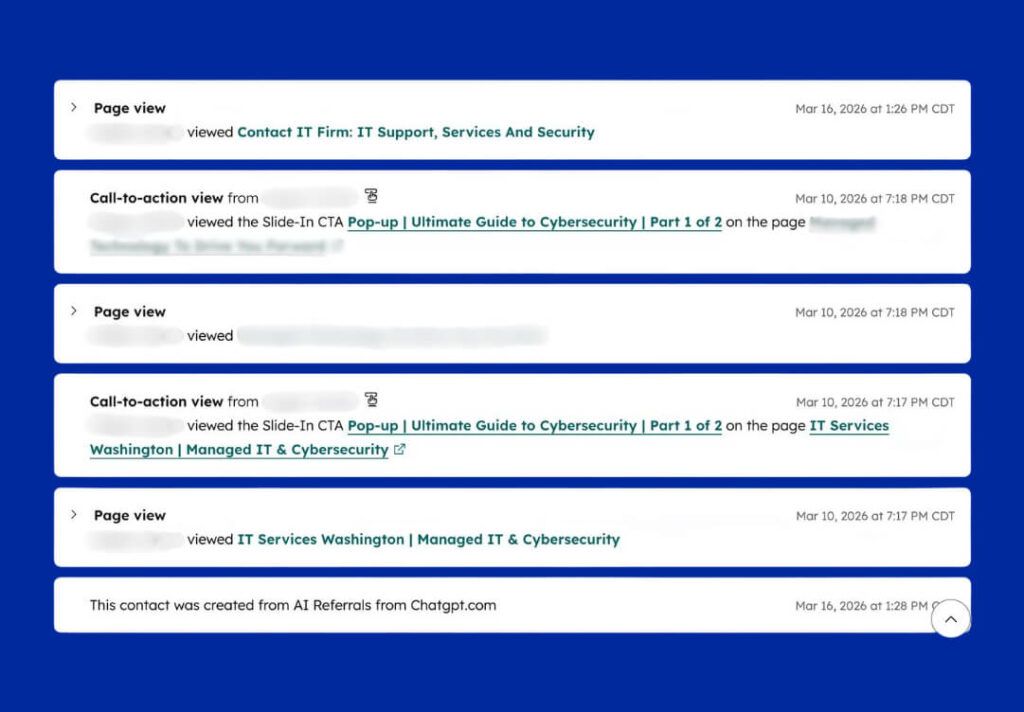
Quick example: Here’s a screenshot showing the buyer journey of a new customer that one of our MSP clients recently closed. ChatGPT recommended our client to the prospect, who then visited several pages on their website. Six days later, the prospect returned to the site and booked a discovery meeting. That prospect ultimately became a closed-won customer, generating $4K in MRR for our client.
Make AI Search Part of Your MSP Marketing Strategy
A practical AI search strategy starts with the buyers you want to attract and the questions they ask when selecting a provider. From there, build clear content, support your positioning with evidence, strengthen your presence across relevant sources, and measure what happens after someone discovers your business.
The most useful question is whether your MSP appears when a qualified buyer describes a need you are well equipped to solve. That gives SEO, AEO, and GEO a shared commercial objective and keeps the work focused on services and markets that can produce valuable contracts.
At DYAD Marketing, we connect SEO and AI search visibility to the outcome that matters: winning more MSP clients. Learn about our MSP SEO services and book a conversation about what that could look like in your market.