
How do you know SEO is working? Here’s the short answer: You know SEO is working when your website becomes more visible in search results, attracts more qualified organic traffic, and generates more conversions over time.
As an SEO practitioner, i’d take this a step further and break it down into page-level and website-level metrics.
Page level:
- Ranking for more keywords
- Ranking hiring for target keyword(s)
- Growing or stable traffic
Website level:
- Conversions on a monthly or weekly basis
- Growing or stable traffic
- Growing backlink profile
- Growing impressions
No single metric can prove that SEO is working. The clearest picture comes from evaluating rankings, visibility, traffic, and conversions together. 99% of the data you need to determine if SEO is working can be found in Google Search Console (GSC) and Google Analytics 4 (GA4).
The Most Important Metrics for Measuring SEO
In my opinion, the most important metrics for measuring SEO are:
- Keyword rankings
- Search impressions
- Organic traffic
- Organic click-through rate
- Conversions
- Conversion rate
These metrics represent different stages of SEO performance.
Keyword rankings and impressions show whether search engines are beginning to recognize and display your content. Organic traffic and click-through rate show whether people are finding and selecting your pages. Conversions reveal whether those visitors are contributing to your business goals.
It is also important to separate page-level performance from website-level performance. A website may experience relatively flat traffic even while several important pages improve. Alternatively, overall website traffic may grow because of one successful article while the site’s service or product pages continue to underperform. Reviewing both levels helps you understand where growth is coming from and whether it is supporting the goals of the business.
Page-Level SEO Performance Metrics
Page-level metrics show how an individual URL performs in organic search. These metrics are especially useful when evaluating a recently published document.
Improving Keyword Rankings
Improving keyword rankings are one of the clearest early signs that SEO is working. When a page moves from position 40 to position 20, it may not immediately generate a meaningful amount of traffic. However, that movement suggests that search engines increasingly view the page as relevant to the query.
Continue monitoring whether the page moves toward the first page of results and whether it begins ranking for other closely related searches. Do not evaluate a page based on one keyword alone. A well-optimized page may rank for dozens or hundreds of relevant variations.
For example, a managed IT service page might target “managed IT services in Denver” while also ranking for keyword variants such as Denver managed IT services, IT services in Denver, IT support services in Denver, etc. Growth across a group of commercially relevant keywords is usually more valuable than improvement for one isolated search term.
Growing or Stable Organic Traffic
A page’s organic traffic should generally increase as its rankings and search visibility improve. Growth may happen gradually. A page may first begin receiving impressions, then occasional clicks, and eventually a consistent stream of visitors as it moves higher in search results.
Stable organic traffic can also be a positive result. Search demand may change because of seasonality, economic conditions, industry trends, or changes to the way Google displays information. If overall demand for a topic is declining, maintaining the same level of traffic may indicate that the page has gained market share. Avoid judging performance based on daily or weekly fluctuations. Compare longer periods, such as the last three months against the previous three months or the same period from the prior year.
Increasing Search Impressions
A search impression is recorded when a page appears in a user’s search results. Increasing impressions usually indicate that Google is displaying the page more frequently or for a broader range of searches. This can happen before the page begins generating significant traffic.
For example, a new article may appear on the fourth or fifth page of Google for several keywords. It may receive impressions without many clicks because few users reach those positions.
As rankings improve, those impressions may begin turning into clicks. Impression growth is therefore an important early indicator of SEO progress, especially for newer pages that have not yet reached the first page of results.
Improving Organic Click-Through Rate
Organic click-through rate measures the percentage of impressions that result in clicks. It can be calculated using the following formula:
Organic click-through rate = organic clicks ÷ organic impressions × 100
A rising click-through rate may indicate that the page’s title and description are becoming more appealing or that the page is moving into more prominent search positions.
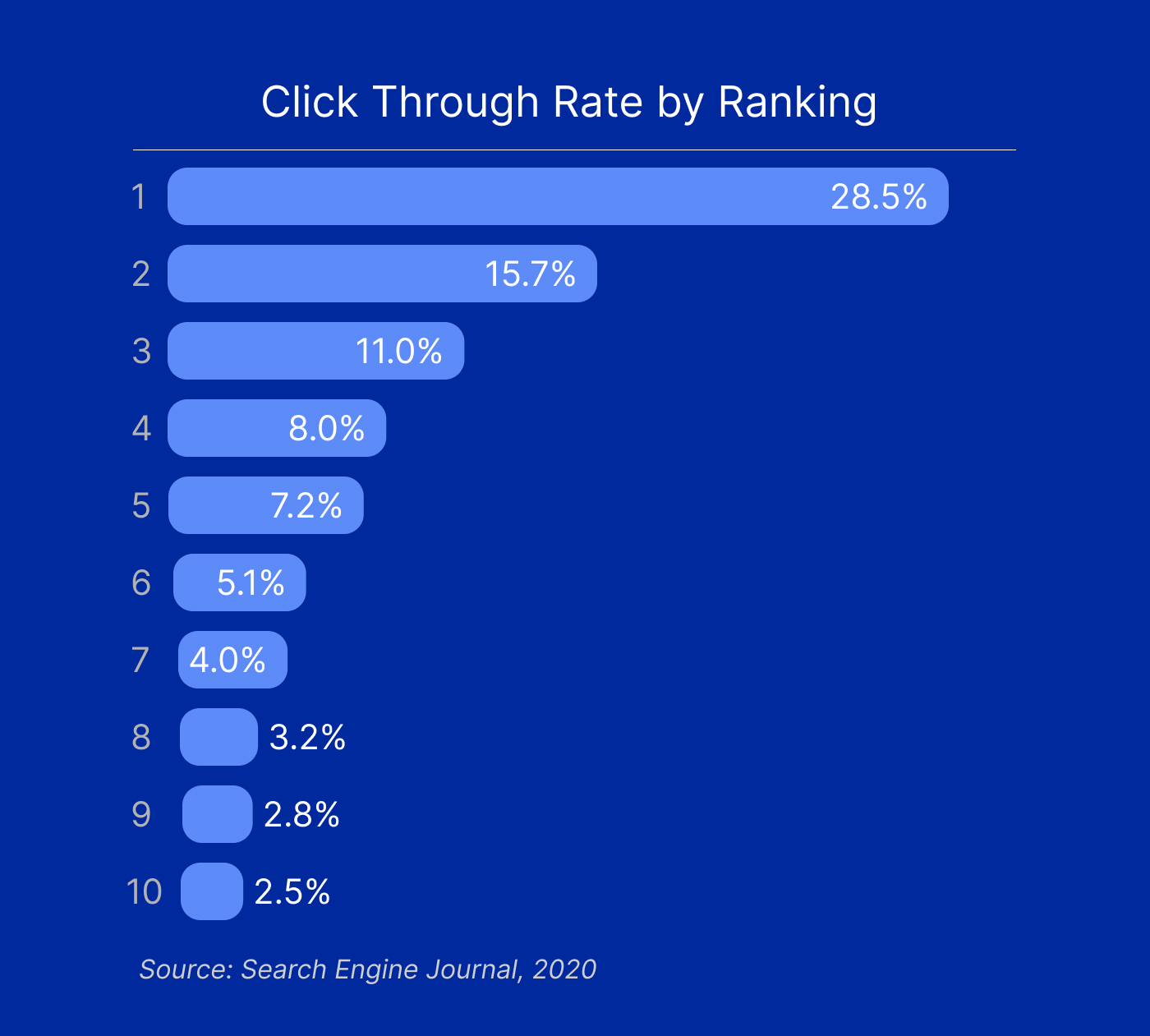
However, click-through rate should always be evaluated alongside rankings. A page in the first position will generally receive a higher click-through rate than a page in the eighth position. A lower rate does not automatically mean that the title tag or meta description is ineffective. Review click-through rate by query and position. If a page ranks well but receives relatively few clicks, the title may not clearly communicate the value of the page or match what the searcher wants.
It’s not perfect, but here’s a chart showing SERP position and expected CTR (assuming there isn’t a local pack)
Generating Conversions
Conversions are the actions you want visitors to complete after reaching a page.
Depending on the website, a conversion may include:
- Completing a contact form
- Calling the business
- Purchasing a product
- Booking an appointment
- Requesting a quote
- Downloading a guide
- Starting a free trial
- Subscribing to an email list
The intended conversion should match the purpose of the page. A product page should contribute to purchases. A service page should generate calls or inquiries. An informational article may encourage readers to visit another page, download a resource, or join an email list.
Traffic without conversions may still have value, especially when visitors are early in the buying process. However, consistent traffic that never contributes to a meaningful action may indicate that the page is attracting the wrong audience or failing to guide visitors toward the next step.
Ranking for More Relevant Keywords
A page does not need to rank higher for its primary keyword to demonstrate progress. It may also begin appearing for a larger number of relevant searches.
This broader keyword visibility shows that search engines are developing a stronger understanding of the page’s subject.
For example, an article targeting “how to know if SEO is working” may also rank for:
- How to measure SEO success
- Signs SEO is working
- SEO performance metrics
- How to track organic traffic
- How to measure SEO conversions
The total number of ranking keywords should not be viewed in isolation. Ranking for unrelated or low-value terms is not necessarily helpful.
Focus on whether the page is gaining visibility for searches that match its topic, intended audience, and business purpose.
Website-Level SEO Performance Metrics
Website-level metrics reveal whether SEO is creating sustainable growth across the site rather than improving only a handful of pages.
Increasing Organic Traffic and Impressions
Growth in organic traffic and impressions indicates that the website is becoming more visible across search engines. Evaluate both metrics because they show different parts of the process.
Impressions measure how often the website appears in search results. Organic traffic measures how often searchers click through to the website. A site may experience strong impression growth before traffic increases. This often happens when new pages begin ranking but remain outside the highest positions.
Compare website traffic month over month and year over year. Year-over-year comparisons are especially useful for seasonal businesses because they compare similar periods.
Growing Organic Leads, Sales, and Conversions
The most important sign of successful SEO is growth in meaningful business results.
Depending on the organization, that may include:
- Qualified leads
- Online sales
- Phone calls
- Booked meetings
- Quote requests
- Software registrations
- In-store visits
Rankings and traffic are valuable because they can lead to these outcomes. They are not usually the final objective. Make sure analytics platforms correctly separate organic conversions from paid advertising, direct traffic, referrals, email marketing, and other channels.
You should also distinguish between conversions and qualified conversions. A campaign that generates 100 low-quality form submissions may be less valuable than one that produces 10 inquiries from ideal customers with a clear need and sufficient budget.
More Pages Are Receiving Organic Traffic
A healthy SEO campaign should gradually increase the number of pages receiving visitors from organic search. A website that depends on one or two high-performing articles is vulnerable. Rankings can change, competitors can publish stronger content, and search demand can decline.
Broader traffic distribution creates greater stability. Review how many pages generated at least one organic visit during a given period. Then identify which types of pages are gaining traffic.
Growth should ideally extend across:
- Service pages
- Product pages
- Location pages
- Educational articles
- Case studies
- Comparison pages
- Industry pages
The right mix will depend on the website and its goals. The important point is that visibility should become more distributed as the SEO strategy matures.
Growing a Relevant Backlink Profile
Backlinks are links from other websites to your website. They can help search engines discover content and evaluate its credibility and authority.
A growing backlink profile can indicate that the website is becoming a more recognized resource. However, backlink quality matters more than total quantity.
One link from a trusted publication, industry association, partner, or relevant local organization may be more valuable than dozens of links from unrelated or low-quality websites.
Evaluate whether new backlinks are:
- Relevant to the website’s industry or audience
- Earned from reputable websites
- Pointing to useful internal pages
- Coming from a diverse group of domains
- Likely to send qualified referral traffic
A sudden increase in low-quality links is not necessarily a sign that SEO is working. Sustainable growth generally comes from valuable content, digital public relations, partnerships, research, tools, and other assets worth referencing.
Earning Referral Traffic From ChatGPT and Other AI Platforms
Analytics platforms may show referral traffic from ChatGPT, Perplexity, Gemini, Copilot, and other AI tools. This traffic may indicate that an AI platform cited, mentioned, or recommended the website while answering a user’s question.
AI referral traffic is still an emerging metric. It is generally much smaller than traffic from traditional search engines and may not appear consistently in analytics platforms.
However, its presence can demonstrate that the website’s content and brand are earning visibility beyond standard search results. Track which pages receive AI referrals, how those visitors behave, and whether they complete conversions.
Do not use AI referral traffic as the primary measure of SEO success. Treat it as an additional signal of visibility that can complement rankings, organic traffic, backlinks, and conversions.
How to Use Search Console for Measuring SEO
As an SEO, Google Search Console is your best friend. GSC is one of the most useful tools for measuring SEO because it shows first-party data on how a website performs in Google Search.
The Performance report provides several core metrics:
- Total clicks
- Total impressions
- Average click-through rate
- Average position
You can filter this information by query, page, country, device, date, and search appearance.
Start by comparing the most recent three or six months with the previous period. Look for changes in total clicks and impressions, then determine which pages and queries contributed to those changes.
Search Console is also useful for identifying situations in which impressions are rising but clicks remain flat. This may mean rankings are improving but have not yet reached prominent positions. It may also indicate that titles and descriptions need improvement.
How to Measure SEO Conversions
Before measuring SEO conversions, define which actions matter to the business.
Primary conversions should represent meaningful outcomes such as:
- Completed purchases
- Qualified form submissions
- Phone calls
- Scheduled appointments
- Demo requests
- Quote requests
Secondary conversions may indicate interest without directly creating revenue. These could include guide downloads, newsletter subscriptions, video views, or visits to a pricing page. Track both types, but avoid treating them as equally valuable.
Set up conversion tracking in your analytics platform and confirm that it records the correct source, landing page, and action. Call-tracking software may be necessary for businesses that receive a large percentage of leads by phone.
For lead-generation websites, connect analytics data with the customer relationship management system when possible. This allows the company to see which organic leads became qualified opportunities and customers. Without this connection, an SEO campaign may appear successful because it generates many leads even though few of them are valuable.
How Long Does It Take to See Results From SEO?
SEO results usually appear in stages. For most niches, it will take 3-6 months to see initial results from SEO and 6-12 months for SEO to contribute pipeline consistently.
The timeline will vary based on factors such as:
- Website authority
- Competition
- Technical condition
- Content quality
- Backlink profile
- Search demand
- Publishing frequency
- Industry and location
A newer website in a competitive industry may require more time to gain visibility than an established website targeting a less competitive market.
Avoid evaluating SEO based on a few days or weeks of data. Rankings naturally fluctuate, and search demand changes throughout the year.
Look for consistent directional improvement across several months. Increasing impressions, broader keyword visibility, and stronger rankings can demonstrate progress even before traffic and conversions increase substantially.
Signs Your SEO Performance Is Not Improving
SEO does not need to improve every month to remain effective. However, several persistent trends may indicate that the strategy needs to be reevaluated.
Keyword Rankings Continue to Decline
Consistent ranking declines across important pages and target keywords may point to larger problems.
The content may be outdated, competitors may have created stronger pages, backlinks may have been lost, or technical issues may be preventing search engines from accessing the site.
It is also possible for the total number of ranking keywords to increase while important commercial rankings decline. Focus on the relevance and value of the keywords, not just the total count.
Organic Traffic Is Not Reaching Important Pages
Traffic growth can be misleading when it is concentrated entirely on informational content. Educational articles can support awareness and introduce visitors to the brand, but the website should also attract searchers to service, product, location, and other commercially valuable pages.
If important pages receive little traffic, review their keyword targeting, content depth, internal links, backlinks, search intent, and technical accessibility. Also examine whether informational pages guide visitors toward the next appropriate step.
Conversion Rate and Leads Remain Flat
SEO traffic that never contributes to leads or sales may not be reaching the right audience.
Possible causes include:
- Targeting low-intent keywords
- Weak calls to action
- Unclear service descriptions
- Poor mobile usability
- Slow page speed
- Complicated forms
- Mismatched search intent
- Inadequate trust signals
Do not assume that SEO is the only problem. The campaign may be attracting qualified visitors while the website fails to convert them. Review traffic acquisition and website conversion performance separately before deciding what needs to change.
Search Console Impressions Are Declining
A sustained decline in Search Console impressions means the website is appearing in fewer searches.
This may be caused by ranking losses, declining search demand, indexing issues, content removal, technical changes, or stronger competition.
Review the decline by page and query. If it affects the entire website, investigate sitewide technical or quality issues. If it affects only a small group of pages, those pages may need to be updated, expanded, consolidated, or better supported with internal links.
How Often Should You Review SEO Performance?
Review high-level SEO performance monthly.
A monthly report should typically include:
- Organic traffic
- Search impressions
- Keyword rankings
- Organic conversions
- Conversion rate
- Top landing pages
- Pages gaining or losing visibility
- New backlinks
Quarterly reviews should examine broader strategic trends. Evaluate whether more pages are earning traffic, whether commercially important topics are gaining visibility, and whether organic search is contributing more qualified opportunities.
Technical problems, major ranking losses, indexing issues, and sudden traffic changes should be investigated as soon as they appear. Avoid making major strategic decisions based on normal short-term fluctuations. SEO should be evaluated through sustained trends rather than isolated daily changes.
Final Answer: How Do You Know If SEO Is Working?
SEO is working when your website earns greater search visibility, attracts more qualified organic traffic, and generates more meaningful business results.
At the page level, look for:
- Improving keyword rankings
- Growing or stable organic traffic
- Increasing search impressions
- A stronger organic click-through rate
- More conversions
- Rankings for a broader range of relevant keywords
At the website level, look for:
- Increasing organic traffic and impressions
- A stronger organic conversion rate
- More leads, sales, and conversions
- More pages receiving organic traffic
- A growing profile of relevant backlinks
- Increasing branded searches
- Referral traffic from ChatGPT and other AI platforms
Rankings, impressions, and traffic are important indicators of progress. However, conversions provide the strongest evidence that SEO is contributing to the growth of the business.